360° Spherical Imaging System – FLIR Ladybug 5
Since the beginning of time, humanity has tried to preserve certain major events. Nothing proves this better than, for example, cave drawings depicting great hunts. With the introduction of the first device that could be considered a camera, the Camera Obscura, this process has been significantly accelerated and simplified. Two-dimensional mappings of the real world, or as it is generally referred to, photographs have been possible for decades. Google Street View has developed a method to take 360° spherical panoramas of streets and stitch them together in their own program. Nowadays, technology is becoming more and more accessible to a wider audience. Google Street View focuses primarily on outdoor spaces, but they also support the digitization of interior spaces. The latter has gained popularity in several sectors. Hospitality and cultural venues are continuously expanding their online presence with simpler 3D panoramas. In addition, it is becoming more and more common for real estate to supplement the traditional offer with virtual touring options, which increases the comfort of potential buyers.
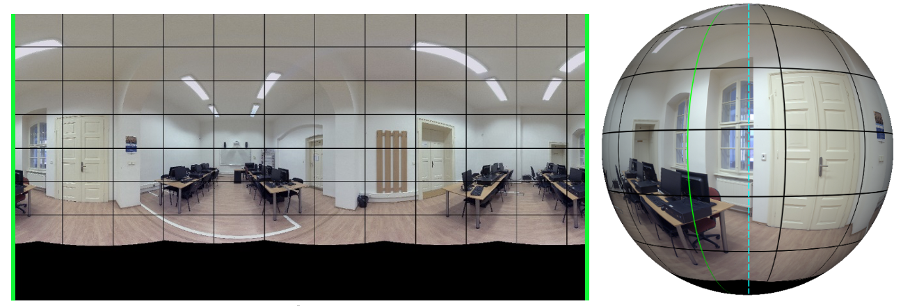
In the case of spherical panorama, the coverage of the upper and lower parts is extremely high, in this case a dedicated camera ensures the recording of the part above the device. The process is far from simple, as the images first become flat, then the finished images regain the shape expected in spherical panorama with the help of joining pictures and alignments. Such recordings at consumer level are often carried out by 2 wide-angle cameras (fisheye optics). Using fewer cameras makes the fitting process easier, but more distortion can occur. More sophisticated devices usually use more cameras, which are more precise in terms of the results, but the image matching process is complicated in proportion to the number of cameras.
Selye János University – Conference Centre
Officers’ Pavilion in Komárno
Ladybug paraméterek
Ladybug 5 is a so-called spherical imaging system developed by Teledyne FLIR. There is a great similarity between individual models, both in design and in knowledge. The differences are mainly observed in image quality and protocols used for communication.
| Description: | LD5-U3-51S5C-44R | 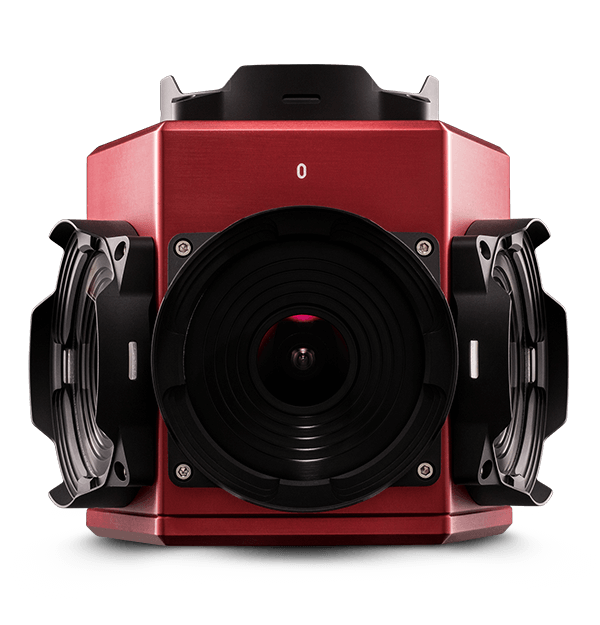 |
| Firmware: | 1.2.3.1 | |
| Resolution: | 2048 * 2448 | |
| Frame rate: | 10FPS JPEG compressed; 5FPS uncompressed | |
| Megapixel: | 30MP (5MP * 6 szenzor) | |
| Sensor: | Sony ICX655 CCD x6, CCD, 2/3” | |
| Input/Output: | USB 3.1, GPIO |
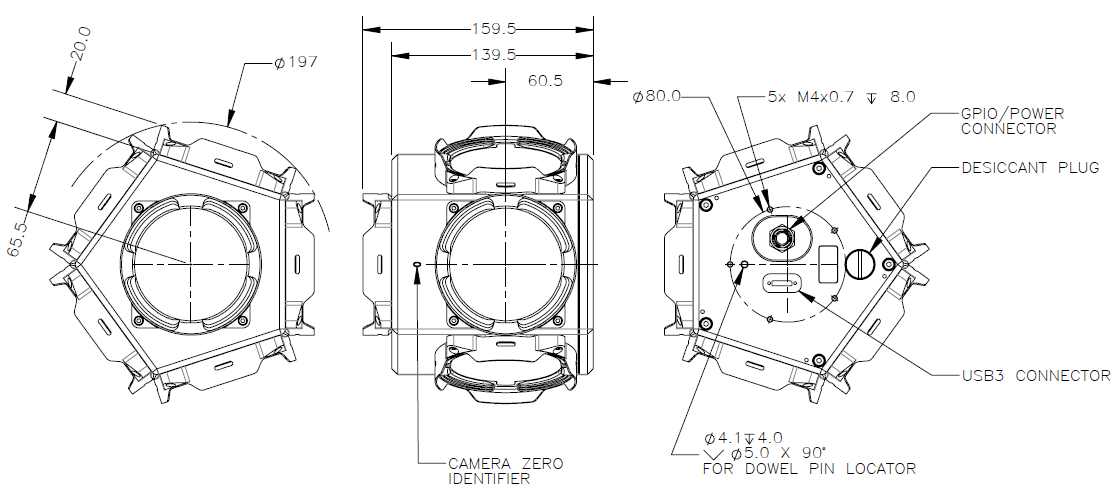
The shape of the Ladybug is a pentagon-based column with cameras on the sides and top, 6 pieces in total. The camera lenses are surrounded by sun visors. The 6 cameras can be adjusted independently. In case of spherical panorama, the cameras take pictures at the same time. The horizontal 5 cameras enclose a regular pentagon, the last one captures the part above the device. The following illustration shows that the location and angle of cameras provide some overlap between images, which is required during stitching. Images of 5 megapixels each are processed to form a standard image with a width of 8192 pixels and a 2:1 screen ratio. On the underside of the device, in addition to the mount design, there is a USB3.1 socket and a GPIO socket.